The Ceiling at Fifteen, and the Shilling Gives Way
- 15.000%
- The ceiling government set
- 24.4%
- Of the 20-year offer taken
- 3,867
- Shilling per dollar, 2026 low
- 13.49%
- New 20-year, after tax
- 1Last week's bond auction: why government turned away Ugx 1.03 trillion on the 20-year rather than pay above 15.000%.
- 2The flat long end, and why a bond issued at exactly 100 is worth real money against one bought at 107.
- 3The shilling's worst week of 2026, and what oil up and gold down together do to Uganda's dollar income.
- 4Wednesday's Federal Reserve decision, and how it reaches the 23rd September bond auction.
- 5Where the whole curve sits after tax, four practical moves, and the local roundup.
Government would not pay more than 15.000% and proved it: investors offered Ugx 1.14 trillion for the new 20-year and it took Ugx 105 billion, less than a quarter of what it had advertised. Beyond ten years the curve is now flat, so the extra reward for lending another decade has gone. Meanwhile the shilling fell 2.2% in five days to its weakest level of 2026, Brent rose 8.65% and gold fell, which is the worst pairing there is for Uganda’s dollar income.
Last week the government held the line on price. This week it is the shilling that is being tested, and on Wednesday the Federal Reserve decides. The next auction is on 23 September, and it will be a harder one to hold.
Weekly Markets Overview: 14 – 18 September 2026
Last week’s bond auction results
| Bond | Type | Price | Yield | Offered | Tendered | Accepted | % sold |
|---|---|---|---|---|---|---|---|
| 3-year | New, 6 Sep 2029 | 100.000 | 12.000% | 230.0 | 498.84 | 249.04 | 108.3% |
| 10-year | Re-opening, 14 May 2037 | 109.795 | 15.000% | 330.0 | 440.67 | 266.02 | 80.6% |
| 20-year | New, 16 Aug 2046 | 100.000 | 15.000% | 430.0 | 1,135.54 | 105.00 | 24.4% |
| Total | 990.0 | 2,075.05 | 620.07 | 62.6% |
What happened?
The 10-year and 20-year bonds both cleared at 15.000%. Normally an investor expects a higher yield for lending for longer, but that extra return has disappeared. The 15-year actually paid more, 15.200%, when it was last issued on 26 August. Ten extra years of risk are currently worth nothing at all.
Investors offered Ugx 1.14 trillion for the 20-year and government accepted Ugx 105 billion of it, against the Ugx 430 billion it had advertised. It was not willing to pay more. The new 20-year cleared at 15.000%, below the older 20-year at 15.650%, and the message is plain: government would rather borrow less than pay above 15.000%.
The new 3-year cleared at 12.000%. So did the 3-year re-opening on 12 August, hence the identical headline rate. But the August bond cost 107.347 per 100 and the new one cost exactly 100.000. When you buy a bond above face value, part of every interest payment is really your own money coming back; tax is charged on the whole payment anyway, and the premium you paid is gone when the bond is repaid. A bond issued at 100 has none of that problem.
Measured against the amount offered, bids across the three bonds came to 2.10 times the Ugx 990 billion advertised, and 2.64 times on the 20-year alone. Just as at the Treasury bill auction a fortnight ago, demand was not what set the rate. The government’s decision about what to accept was.
Investors offered Ugx 1.14 trillion for the 20-year. Government took Ugx 105 billion of it, and the rate stopped at fifteen.
What happened internationally?
US inflation stayed at 3.4% in August, unchanged from July, with core inflation at 2.4%. The detail was less comfortable than the headline. Energy prices rose 2.1% in the month and 16.3% over the year, with petrol accounting for more than a third of the monthly increase, and producer prices rose 0.4% in the month and 5.4% over the year. Price pressure has not gone away.
That has raised expectations that the Federal Reserve will lift interest rates on Wednesday. Investors are confident rates are going up, though estimates of the size and the odds vary. These are market expectations, not an announcement: US rates today are 3.50–3.75%.
Two price moves matter more to Uganda than the inflation print itself. Brent crude reached $104.61 a barrel on Friday, up 8.65% on the week, on tension around the Strait of Hormuz and disruption to Saudi production. Gold fell 1.2% to about $4,349 an ounce, its lowest in more than a month, because higher American rates make an asset that pays no interest less attractive to hold.
The Federal Reserve decides on Wednesday
The Federal Open Market Committee meets on 15–16 September and announces its interest-rate decision on Wednesday. Markets already expect a 0.25% increase, which would take US rates to 3.75–4.00%. The bigger question is what the Fed signals about the increases after this one: if its own forecasts show more than investors expect, the dollar strengthens further.
That reading reaches Uganda’s 23 September bond auction directly. A weaker shilling and higher global rates make it harder for government to reject expensive bids the way it did last week. The Chair’s remarks after the decision will therefore matter as much as the decision itself.
Where the curve sits at the end of the week
This is the table that matters, not the auction. The dates in the first column say which bond was auctioned when; the yields say where that same bond was trading on Friday. Withholding tax is 20% on anything originally issued within ten years and 10% at ten years and over, so what you keep is the column on the right.
| Instrument (auction date) | Yield, 11 Sep | WHT | After tax | Real return |
|---|---|---|---|---|
| 91-day bill (2 Sep) | 9.864% | 20% | 7.891% | +2.141% |
| 182-day bill (2 Sep) | 9.847% | 20% | 7.878% | +2.128% |
| 364-day bill (2 Sep) | 10.781% | 20% | 8.625% | +2.875% |
| 2-year (26 Aug) | 11.722% | 20% | 9.378% | +3.628% |
| 3-year, new (9 Sep) | 11.903% | 20% | 9.522% | +3.772% |
| 5-year (26 Aug) | 13.669% | 10% | 12.302% | +6.552% |
| 10-year (9 Sep) | 14.967% | 10% | 13.470% | +7.720% |
| 15-year (26 Aug) | 15.000% | 10% | 13.500% | +7.750% |
| 20-year, new (9 Sep) | 14.991% | 10% | 13.492% | +7.742% |
Read down the last two rows and the week’s argument is there in one line. The 15-year keeps 13.500% and the new 20-year keeps 13.492%. Five extra years of risk are worth less than nothing, and the 10-year is within three basis points of both.
Four moves before the 23rd
It has already lost about 2.2% against the dollar in five days, and that affects what your money is worth by the time the auction comes. The currency, not the inflation print, is the variable to follow this week.
The 10-year and 20-year bonds offered almost the same return last week, and they are trading within a whisker of each other now. In plain terms, locking your money away for another decade buys you almost no extra return, so there is little reason to pay for the privilege in flexibility.
At current rates the new 3-year keeps about 9.52% after tax against 8.63% on the 364-day Treasury bill, and it was issued at exactly 100, so none of the premium problem applies. Confirm the tax rate with your dealer before you invest.
Both instruments carry 20% withholding. The 3-year figure is its Friday market yield of 11.903% less that tax; the bill’s is its 10.781% yield less the same. The 3-year was issued at par, so nothing further is lost to a premium.
Government plans to borrow less from July 2027, but it still expects to raise about Ugx 25.9 trillion locally before then, so auctions are likely to run much as they have. The reduction also depends on it collecting more tax. December’s Budget Framework Paper will give the first real picture.
Prepared by Glen Busobozi and Lutaaya Victor
Other local news
It moved from about 3,774 per dollar on 7 September to 3,867 on 11 September, a fall of roughly 2.2% in five days and the weakest the shilling has been all year. An independent rate series puts the same day at 3,868.30 and also records it as the 2026 high for the dollar. The cause is not local: higher expected American interest rates make dollars more attractive to hold, so money moves out of currencies like ours. Uganda imports all of its fuel, so this reaches pump prices within weeks.
Trading on the Uganda Securities Exchange has almost doubled, reaching Ugx 101.8 billion by the end of August against about Ugx 56 billion last year. It remains concentrated in a few names: MTN accounted for 69% of the money traded, Stanbic 21% and Umeme 5%.
The rise is encouraging, driven by stronger company results, dividends and greater investor interest. But the market is still thin, which means a large investor may struggle to sell a big holding quickly without moving the price.
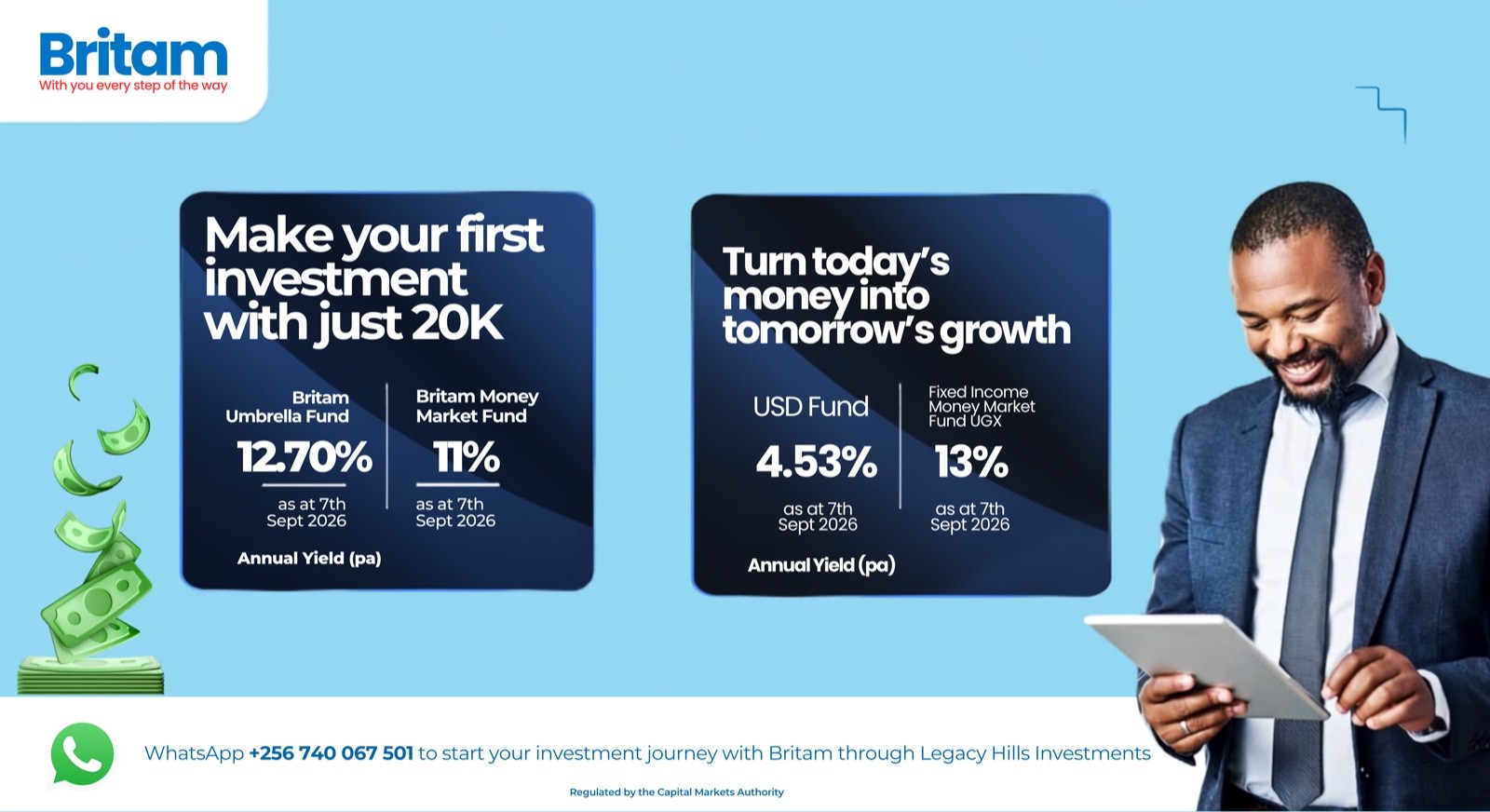
The Umbrella Fund is earning 12.94% a year, a relatively attractive return with flexibility and a Ugx 20,000 entry point. The Money Market Fund, at 11%, suits shorter-term savings and easy access; the Fixed Income Money Market Fund (UGX), at 13%, pays more for investors seeking income from fixed-income holdings. For diversification beyond Uganda, the USD Fund is at 4.53%. Which one fits depends on your return expectations, time horizon, currency needs and how quickly you need your money back.
On 7 September, Governor Michael Atingi-Ego said Uganda’s high interest rates are partly driven by heavy government borrowing: when government takes a lot from the local market, less is left for businesses and individuals, which pushes bank lending rates up. The Bank also disclosed security incidents involving lost laptops and fraudulent payments. The Governor said weaknesses had been identified and systems strengthened, but declined to give details, saying those would be discussed privately with Parliament.
On Thursday 10 September the finance minister met stakeholders at Munyonyo to open work on the budget for the year starting July 2027, the first step in a process that ends with the Budget Speech next June. No figures have been set. What was announced is a direction rather than a number: new loans only for projects that can show a return, spending the loans already signed for instead of leaving the money unused, and cutting spending it does not consider a priority. This reaches ordinary investors because government borrows from two places, from abroad and from us, through the Treasury bills and bonds it auctions. Consultations run around the country until 2 October, and the actual figures arrive in the Budget Framework Paper, around December.
Fund managers Legacy Hills advises for
Legacy Hills Investments works alongside a select group of Uganda’s licensed fund managers, giving our clients access to unit trust and money market options across the industry rather than a single house view. The partners below are the names you will see referenced across our research.
- 01Old Mutual Investment Group Uganda (OMIG) Limited
- 02Britam Asset Managers Company (Uganda) Limited
- 03ICEA Lion Asset Management Uganda Limited
- 04SBG Securities Uganda Limited
- 05Sanlam Allianz Investments Limited
- 06GenAfrica Asset Managers
- 07Cornerstone Asset Managers Limited
- 08Kura Asset Managers
- 09Xeno Investments
- 10NSSF Uganda
A price government set, a price it cannot
Last week showed how much control the government still has over one number. It wanted Ugx 990 billion, was offered Ugx 2.08 trillion, took Ugx 620 billion and did not pay a basis point above fifteen. The shilling is the number it does not set, and that one moved 2.2% in five days while oil rose and gold fell. On Wednesday Washington decides, and on the 23rd the government comes back to the market to borrow again. Holding the line at fifteen will cost more next time.
Published by Legacy Hills Investments Limited, an independent investment advisor. This newsletter is for general information only and does not constitute investment advice. Figures are drawn from Bank of Uganda, Uganda Bureau of Statistics and public market reporting. Investors should confirm current rates before making decisions.